Window Replacement in Bellevue: What the Project Involves, Step by Step
Most homeowners think of a window replacement as a day when a crew shows up, pulls the old units, and sets the new ones. That’s the middle of the story, not the whole of it. A window replacement in Bellevue runs from a pre-project assessment through permit close-out, and the window itself is only about half the total cost and effort. The other half is assessment, permitting, flashing, air sealing, interior finish, and disposal. That’s the half that separates an installation that holds up from one that leaks, and it’s also the half that quietly vanishes from a low-ball estimate. If you’d rather not sort through it alone, call (425) 699-3164 and we’ll walk you through it.
Why the Full Project Scope Matters More Than the Window Spec Sheet
When you compare quotes on a window replacement in Bellevue, the line items that look optional are usually the ones that determine how long the installation lasts. A window is a manufactured product with a known spec: glass package, frame material, U-factor, and hardware. The installation around it is custom work that depends on your wall assembly, your cladding, and how carefully the crew treats flashing and air sealing. Two projects can use the same CGI or CWS window and end up with wildly different performance because one crew sealed the rough opening correctly and the other caulked over a gap.
That’s why we push homeowners to read the scope, not just the price. A good estimate tells you:
- Which replacement method is being used, pocket or full-frame, and why
- What happens to the existing frame and trim
- How the rough opening gets flashed and air-sealed
- Who handles interior finish carpentry and exterior trim
- Who pulls the permit and who pays for it
- How old windows and debris leave your property
A quote that lists only windows and labor isn’t lying, exactly. It’s just incomplete. In our experience, the missing items are what comes back as a change order once work is underway.
Phase 1: Assessment and Specification
The first phase of a window replacement project in Bellevue is a thorough evaluation before anyone orders product. A good assessment answers four questions: what condition is the existing frame in, how deep is the wall, what are the true rough opening dimensions, and what kind of exterior cladding does the home have. Each answer shapes which products fit and which replacement method makes sense.
Frame condition gets skipped most often. If the existing wood frame is soft, out of square, or has prior water damage, a pocket replacement is a bad idea no matter how much cheaper it looks on paper. The new window has to attach to something solid. Wall depth matters too, especially on older homes where the wall assembly was built to a different standard than what a modern energy-efficient unit expects. Cladding type – stucco, wood siding, brick veneer, fiber cement – determines how the exterior gets flashed and trimmed, which is where water intrusion problems usually start.
Rough opening dimensions need to be measured, not assumed. A window that’s a quarter inch tight will fight the crew all day and may not seal correctly. We measure every opening individually because in most homes they aren’t uniform.
This phase is also where brand and product decisions get made. Working across eight manufacturer brands – PGT, CGI, CWS, ES Windows, ECO Window Systems, Mr-Glass, Therma-Tru, and ViewLux – means we can match a product to your home’s real requirements instead of steering you toward one catalog. The right product for your home, not just the product we have in stock.
Phase 2: Permit and Product Lead Time
Bellevue requires a permit for window replacement in most cases, and the permit process runs in parallel with product ordering. Neither is instant, and both affect when the crew actually shows up. Homeowners who plan the project around the installation date alone often get blindsided by a two or three week gap waiting for either.
On the permit side, the City of Bellevue’s permit turnaround depends on the project scope, how complete the application is, and current volume at the building department. A straightforward replacement of like-for-like units usually moves faster than a project changing the size or number of openings. We submit the application with product specs, installation details, and site information so review doesn’t stall on missing paperwork. If the project changes openings, expect a longer review.
Product lead time is the other clock. Impact-rated units from PGT and CGI can take longer to build than a standard energy-efficient unit from CWS or ES Windows, because the glazing assembly is more involved. Custom sizes add time on any brand. Standard sizes ship faster. ECO Window Systems and ES Windows tend to have more predictable lead times for common configurations, while specialty or oversized units stretch further out.
The practical advice: lock the product choice first, submit the permit in parallel, and set the install date after both are confirmed. Don’t let a contractor promise an install date before the permit and the product are both real.
Phase 3: Installation Day Scope
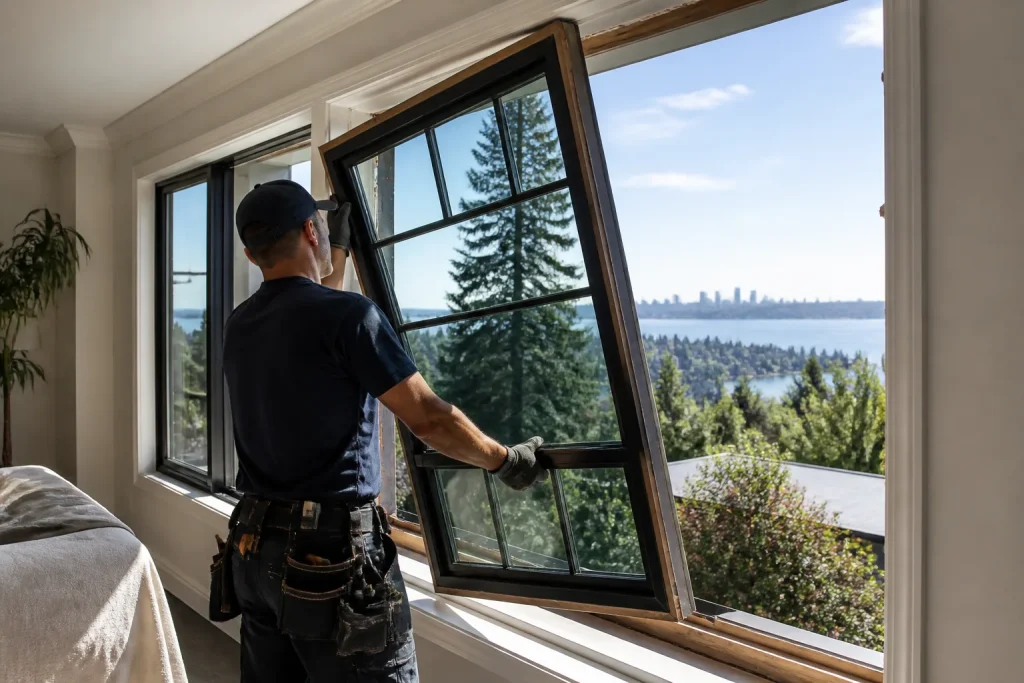
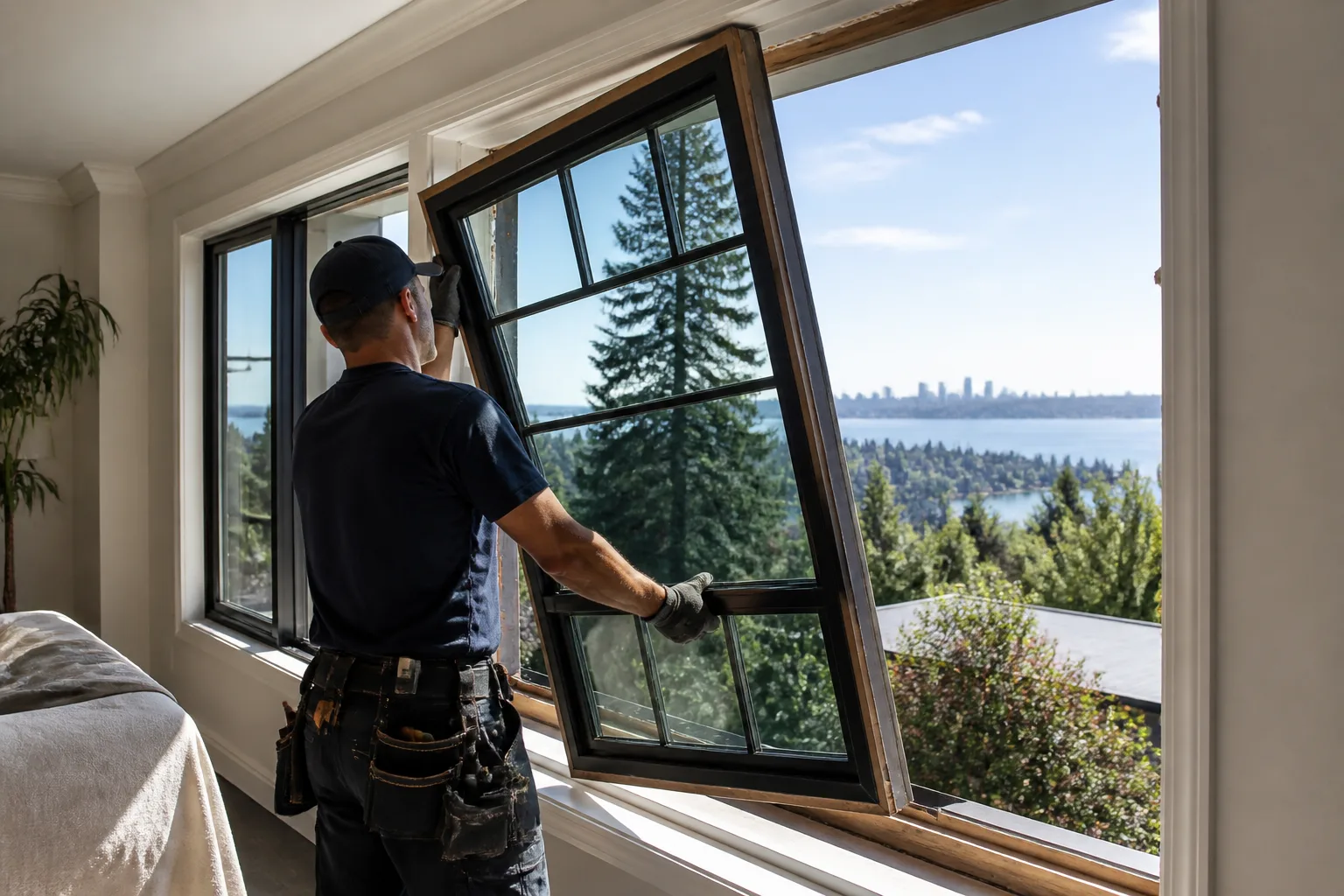
Installation day is the phase homeowners picture, and it’s genuinely the most visible part of the project. The crew protects flooring and furniture, removes the old units, preps the rough openings, installs and flashes the new units, and seals them. Each stage has a duration that depends on the project, but the sequence is consistent. A typical residential project takes one to three days for the window scope depending on how many openings are involved and whether it’s a pocket or full-frame job.
Site conditions can stretch the timeline. Tight access on a steep lot slows the crew down. Rain, which is a real factor in Bellevue’s climate for much of the year, can pause exterior work mid-day. Existing damage discovered during removal – soft sheathing, rotted framing, failed flashing from a previous installation – adds repair time before the new product goes in. None of that is unusual here. A contractor who’s worked in this climate knows to build weather contingency into the schedule instead of pretending every day is dry.
Full-frame replacement takes longer than pocket replacement because the entire window assembly, including the frame, comes out. That means more demolition, more rough opening prep, and more flashing detail. The upside is that any hidden damage gets addressed and the installation is truly new, not new product inside an old frame. For homes where the existing frames are sound, pocket replacement is faster and less invasive. Where they aren’t, full-frame is the only honest choice. The right method depends on frame condition, not on which one is quicker or cheaper.
Phase 4: Interior Finish and Permit Inspection
Once the window installs are complete, a finish carpenter usually handles the interior side: trimming out the newly installed units, patching drywall where the old trim didn’t cover, and matching the existing interior finish as closely as the home allows. This step is often bid separately and is one of the reasons a low estimate looks lower than it should. If the estimate doesn’t mention interior finish, ask who’s doing it.
Permit inspection is the closing step. A final inspection typically checks that the installed units match the permitted product, that flashing and sealing were done as specified, and that the installation meets applicable code. The homeowner should keep the permit paperwork, the product specification sheets, the manufacturer warranty documents, and the contractor’s workmanship warranty together – all in one file. Any future insurance claim, resale disclosure, or warranty service will need them.
If you’re also replacing exterior doors as part of the project, coordinating door replacement in the same scope keeps interior trim, exterior flashing, and inspection under one contractor.
How Replacement Method Changes the Project
Pocket replacement fits a new window into the existing frame. Full-frame replacement removes the entire window including the frame and installs a complete new assembly into the rough opening. The choice changes the schedule, the scope, and what you end up with a decade later.
Pocket installations are faster, less invasive, and easier on interior finishes. They work well when the existing frame is solid and the home is keeping its current window sizes. The limitation is that you inherit the existing frame and any problems hiding in it. Full-frame replacement costs more up front but gives you a true new installation, with fresh flashing and sealing at the rough opening, which is where water intrusion usually originates.
If a contractor offers only one method regardless of your home’s condition, that’s worth noticing. The right choice depends on frame condition, not on the calendar. For a broader look at what a full replacement project involves, see our window replacement overview. If your project also includes new openings or additions rather than straight replacement, the scope of window installation is worth reviewing before you commit.
When to Call a Pro
If two or more of these apply, it’s time to bring in a contractor rather than a handyman:
- Any existing frame is soft, rotted, or shows prior water damage
- The project changes window sizes or adds openings
- Permits are required and you’re not comfortable managing the submittal
- Interior trim needs to be reworked to match existing finish
- The project includes doors as part of the same scope
Our technicians have up to 10 years of experience with residential window and door installation. If you’re evaluating multiple quotes, we’re happy to review the scope side by side with you.
Related services in Bellevue: window replacement in Bellevue for the broader project scope, plus door replacement and window installation when your project extends beyond straight replacement.
The Bottom Line
A window replacement in Bellevue is a permit-driven, multi-phase project, not a one-day event. The assessment determines whether pocket or full-frame is the honest answer. The permit and product lead time together define when install can actually happen. The install day scope depends on site conditions and existing damage. Interior finish and final inspection close the loop. When you’re comparing estimates, look for the project scope, not just the window price – the low estimate almost always shrinks the work that happens around the window.
If you’re in Bellevue and need help pulling a scope together or want to see how the full project reads on paper, Window Replacement Bellevue offers free estimates – call (425) 699-3164. We’ll tell you which brands fit your project and why, and we’ll show you what the estimate includes at every phase.
Frequently Asked Questions
Most residential window replacement projects in Bellevue run one to three days for the actual install, but the full project from assessment to final inspection typically spans several weeks because permit review and product lead time happen before the crew is on site. Custom sizes and impact-rated glazing add time.
In most cases, yes. The City of Bellevue’s building department requires a permit for window replacement, and the review timeline varies by scope. Projects that change opening sizes or counts usually take longer than like-for-like replacements. Call (425) 699-3164 if you want help understanding your project’s permit requirements.
Pocket replacement is right when the existing frames are sound and window sizes aren’t changing. Full-frame replacement is the better choice when frames are damaged, out of square, or have prior water intrusion, because it gives you a new rough opening connection with fresh flashing. The honest answer depends on your home, not on which method is faster.
We take window and door replacement or installation projects of three openings or more. Smaller jobs are better handled by a handyman service. Call (425) 699-3164 to talk through your project scope and get a free estimate.
Written by the team at Window Replacement Bellevue.
Need Windows & Doors Help?
Call Window Replacement Bellevue - the local pro we connect you with is licensed and insured, here with fast after-hours help in Bellevue.
(425) 699-3164